Internal vs. External Penetration Testing: Which Does Your Business Need?

A prospect asks for a penetration test before signing a contract. You contact a provider, and the first question is whether you need internal or external testing.
External penetration testing examines exposure from the internet. Internal penetration testing examines what someone with an agreed level of internal access could do. The appropriate choice depends on the systems, access paths, and business risks you need assessed.
You may need one assessment, both, or a more focused application or API test. Start with the question you need answered, then define the coverage.
How internal and external penetration testing compare
The table below describes common engagement models. Your agreed scope determines the actual targets, starting access, permitted activities, and exclusions.
| Comparison | External network penetration testing | Internal network penetration testing |
|---|---|---|
| Starting position | From the internet, usually without internal access | From an agreed position within a private network, with credentials if included |
| Main question | What could someone exploit through our public network services? | What could someone do with this internal foothold? |
| Example targets | Public servers, remote-access gateways, and exposed network services | Private servers, file shares, identity systems, and network boundaries |
| Risks examined | Exploitable exposed services and weaknesses in internet-facing access controls | Movement between systems, excessive permissions, and paths to higher privileges |
| Useful trigger | New public infrastructure, substantial external changes, or a customer requirement | Concern about a compromised device or account, or whether internal boundaries hold |
| Coverage to confirm separately | Authenticated application workflows, business logic, and API authorization | Other network segments, cloud identity controls, and detailed application testing |
“Internal” and “external” describe the testing perspective. Either assessment can be performed by an outside penetration testing company. Internal testing can also be delivered remotely.
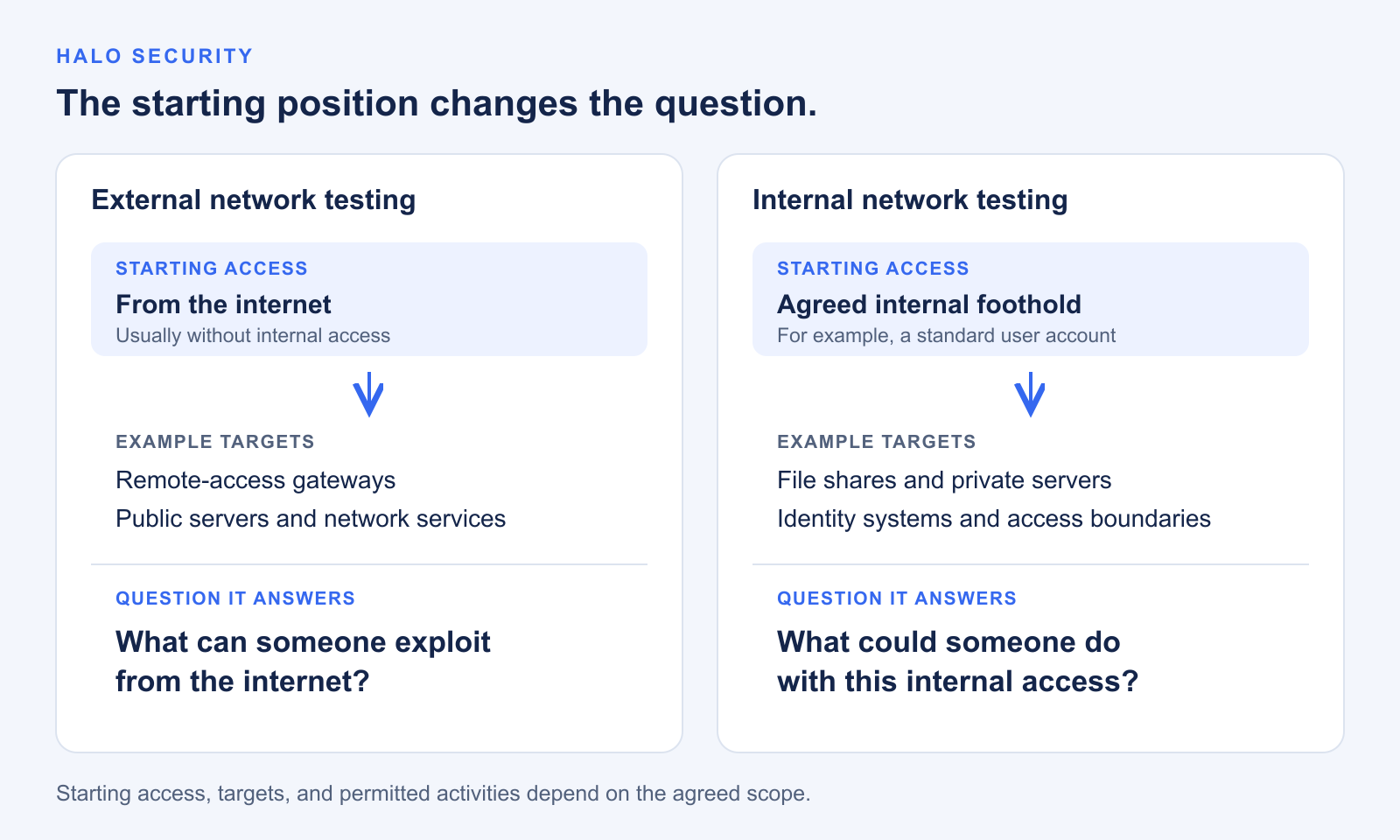
The tester’s starting access determines what can be examined
For internal testing, network access and account permissions are separate scoping decisions. A tester might begin with access to a particular network segment, an ordinary employee account, or a workstation representing a compromised device. Administrator credentials are not an automatic requirement.
The access method also shapes coverage. A remote connection that reaches selected servers may expose different paths than a device connected to an employee network. Agree on the position being simulated and whether it represents the scenario you want assessed.
NIST SP 800-115 distinguishes external and internal testing viewpoints and describes setting internal access according to the assessment’s objectives.
For a buyer, this means the proposal should say more than “internal pentest.” It should identify where the tester starts, what access they receive, and which systems they may attempt to reach.
External testing examines exposure from the internet
External network penetration testing is useful when you want to assess internet-facing infrastructure and remote-access services. That may include public servers, VPN gateways, and other approved services reachable from outside your organization.
Common reasons to commission it include deploying new external systems, substantially changing existing infrastructure, or investigating whether exposed weaknesses are exploitable. A customer may also specifically request external network testing. Bring the written request into scoping so the provider can match the assessment to it.
Suppose your company introduces a new remote-access gateway. An external test could examine its publicly reachable services and investigate whether weaknesses could permit unauthorized access. The scope would establish the permitted techniques and how far testing could proceed if access were obtained.
A vulnerability scan can help identify potential issues. A penetration test adds investigation and controlled attempts to validate weaknesses and demonstrate their consequences within the agreed limits.
Halo’s external network penetration testing service addresses these internet-facing network risks. Deep testing of every website, authenticated workflow, or API is coverage to specify separately.
Internal testing examines the consequences of an internal foothold
Internal network penetration testing investigates what could happen after someone obtains the agreed starting access. It can help answer questions such as:
- Could an ordinary account gain higher privileges?
- Could access to one system lead to sensitive servers or file shares?
- Do network boundaries restrict access as intended?
- Could weaknesses in identity systems create access across multiple systems?
This is useful beyond malicious-insider scenarios. A compromised employee device or stolen account could also provide the starting point.
Suppose a company has employee workstations, shared project files, and administrative systems intended to be accessible only to IT staff. An internal assessment could begin from an employee network with an ordinary account and investigate whether those boundaries hold.
If the agreed testing revealed excessive file permissions or a path from a workstation to an administrative system, potential fixes could include narrowing permissions, restricting network access, or correcting identity configuration. The findings would depend on what the tester could demonstrate.
Halo’s internal network penetration testing service examines risks including movement between systems, privilege escalation, and network segmentation weaknesses.
A test from one starting position does not automatically cover every private network. If you need to compare employee, contractor, and server environments, identify those perspectives during scoping.
Internal and external testing can answer complementary questions
Combining the assessments can be useful when you need to understand both public exposure and the consequences of internal access.
Suppose a business operates public remote-access infrastructure alongside private finance servers and administrative systems. External testing could examine whether the public services offer an exploitable entry path. Internal testing could investigate whether a foothold on an employee network could lead to the finance environment.
The findings could require different fixes. An exposed service might need patching or tighter public access restrictions. An internal path might require changes to account privileges, file permissions, or network boundaries.
An internal test can begin from an assumed foothold even if the external assessment finds no entry path. That allows the business to evaluate internal controls without making the assessment depend on a successful external compromise.
The scope should establish whether these are separate assessments or an engagement that permits progression from external access into internal systems. Finding an entry point does not itself authorize testing everything reachable through it.
Cloud and remote businesses still have access boundaries to assess
An office network is only one possible environment. A business with remote employees may still operate public services, private cloud networks, administrative systems, and identity controls that separate users from sensitive resources.
Map those boundaries before selecting a test. Identify what is publicly reachable, what requires private connectivity, and what employees or administrators can access with their accounts.
Public cloud-hosted network services may fit an external assessment. Private cloud servers and access between network segments may fit an internal assessment. Cloud configuration and identity permissions may need additional, explicitly defined coverage.
For a SaaS company, the main concern may be whether one customer can access another customer’s data. That question calls for application and API testing focused on authorization, user roles, and customer separation.
Choosing “external” because the product is available online does not establish that coverage. A network assessment might examine the server hosting an application without thoroughly testing how the application handles a logged-in customer’s requests.
Describe the failure you want investigated, such as “Could one customer retrieve another customer’s records?” That gives the provider a concrete objective to scope.
Choose coverage around the decision you need to make
Use your objective to guide the conversation with a provider.
| Your objective | Coverage to discuss |
|---|---|
| Assess a new remote-access gateway or changed public infrastructure | External network testing of the relevant systems and access paths |
| Validate whether exposed network weaknesses are exploitable | External network testing with agreed validation activities |
| Understand what a compromised employee device or account could expose | Internal testing from a representative starting position |
| Check separation between employee systems and sensitive servers | Internal testing with explicit coverage of those boundaries |
| Assess both internet entry paths and potential internal consequences | Coordinated external and internal testing |
| Test customer data isolation, user permissions, or API access controls | Application and API testing |
| Respond to a customer or audit request | Map the written requirement to specific targets, methods, and deliverables |
If budget requires phasing, prioritize with the provider based on your immediate objective, recent changes, sensitive systems, and deadlines. Document the coverage being deferred and what questions will remain unanswered.
A business launching a new gateway may prioritize external testing. Another business investigating access to sensitive internal files may prioritize an internal assessment. Neither sequence applies universally.
For help defining those boundaries, see Choosing the Right Scope for Your Next Pentest. When comparing proposals, use 12 Questions to Ask a Penetration Testing Company Before You Hire Them. For budgeting, read How Much Does a Penetration Test Cost?.
Prepare for scoping with the information you already have
You do not need a complete inventory or a preferred test type before contacting a provider. Bring:
- Your reason for testing, including any written customer or audit request.
- A basic description of public and private systems, including cloud infrastructure and employee access.
- The sensitive data or business functions you want protected, such as customer records, financial operations, or administrative access.
- Known access arrangements, operational constraints, and deadlines, including systems that require special handling.
The resulting scope should make clear what the assessment can establish and where coverage stops. Findings reflect the systems, access, methods, and testing period involved. A pentest does not prove that all systems are secure or guarantee compliance.
Halo’s penetration testing process begins with defining goals, targets, and timing. Clients work directly with their assigned tester and receive practical reporting, remediation guidance, and included retesting to validate fixes.
Find the right scope for your next pentest.
Tell us what you need to protect and what prompted the test. We’ll help you determine whether internal, external, application testing, or a combination fits your goals.